


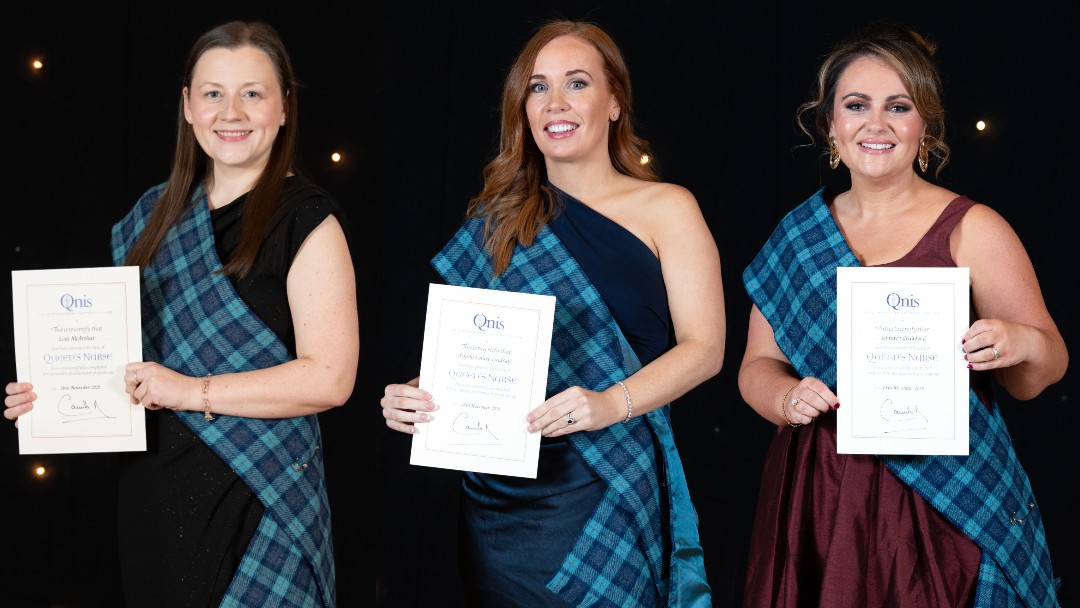
Three outstanding nurses from Lanarkshire have achieved one of the highest accolades in community nursing – the prestigious Queen’s Nurse award.
Lisa McArthur (pictured left), Advanced Tissue Viability Nurse Specialist, Emma Lindsay (centre), Team Leader for Health and Homelessness and Jennifer Crawford (right), Health Visitor Team Leader were selected earlier this year to take part in a nine-month development programme run by the charity Queen’s Nursing Institute Scotland (QNIS).
After completing the programme successfully, they were awarded the Queen’s Nurse title along with 15 other community nurses at a ceremony staged on Friday (28 November) evening in Edinburgh.
Debi Robertson, Deputy Associate Nurse Director for South Lanarkshire University Health and Social Care Partnership, said: “I am absolutely delighted to congratulate Lisa, Emma and Jennifer on being awarded the prestigious title of Queen’s Nurse.
“This achievement reflects your exceptional commitment to person-centred care and your unwavering dedication to improving the health and wellbeing of our communities. Thank you for the passion, professionalism, and compassion you bring to your roles every day, you truly make a difference.”
Professor Soumen Sengupta, Chief Officer for South Lanarkshire University Health and Social Care Partnership, added: “As we head into the challenging winter months, I want to take this opportunity not only to congratulate Lisa, Emma and Jennifer on this remarkable achievement, but also to recognise and thank all of our nursing colleagues.
“Your tireless efforts, resilience and commitment to supporting the people of Lanarkshire are deeply appreciated. Together, you continue to make an extraordinary impact on the lives of those we serve.”
Queen’s Nursing in Scotland dates back to the late 19th century, when nurses completed specific training which allowed them to work as district nurses to provide nursing care for the ‘sick poor’ of Scotland’s communities. QNIS organised the training of District Nurses in Scotland until the late 1960s.
Nurses who qualified from the Institute were known as Queen’s Nurses, who provided healthcare and health promotion to people in their own homes and became well respected figures within their community. Following the introduction of a national certificate for district nursing, QNIS ceased training, awarding the original QN District Nursing title for the final time in 1969.
The Queen’s Nurse title was reintroduced to Scotland in 2017, with around 20 community nurses and midwives chosen each year to embark on the Queen’s Nurse Development Programme (QNDP) after which they are awarded the title of Queen’s Nurses. There are now almost 200 contemporary Queen’s Nurses working across Scotland.
This year, 18 community nurses were selected to complete the nine-month programme which consists of residential workshops, online workshops and individual coaching sessions.
The programme requires them to choose an issue for development which will have a significant impact on those they care for, so that the learning during the nine months is applied in practice. There is an expectation that this work will have a focus on promoting health equity and inclusion.
Community nurses and midwives provide a wide range of support to the people in their communities including complex care for older people, support for substance misuse and advocacy for people with learning disabilities. Those working in community mental health, district nursing, school nursing, care home nursing and health visiting are also part of this vital group of health professionals.
Dr Sarah Doyle, QNIS Chief Executive and Nurse Director, said: “QNIS is delighted to award the Queen’s Nurse title to these fantastic nurses.
“Community nurses and midwives occupy a unique position, working as they do in the heart of communities, championing the cause of those who are marginalised, helping those facing real adversity. They do vital work, every day. The Queen’s Nurse Development Programme supports participants to build their confidence, inspiring them to find and lead creative responses to the challenges they face, and to improve the provision of health and social care in Scotland.”
