


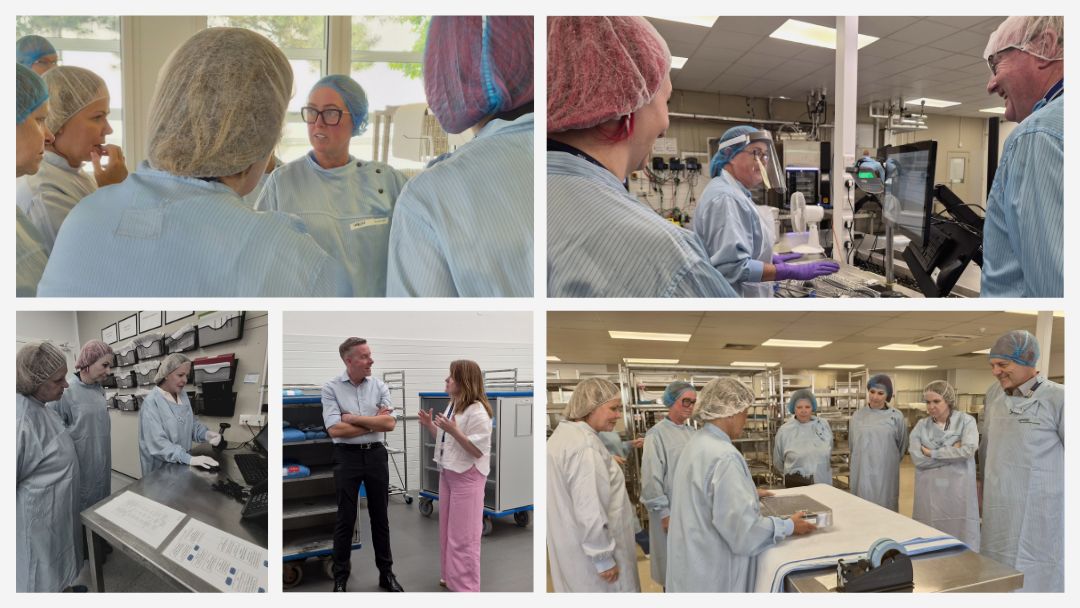
Members of the Board of NHS Lanarkshire took part in a leadership walk-round of the STERIS decontamination facility in Bellshill to see first-hand the work that goes into ensuring surgical instruments are safely processed and ready for use across our hospitals.
The visit gave Board members the opportunity to follow the full decontamination process, from instruments arriving at the facility through cleaning, inspection, tray setting and sterilisation to final quality checks and despatch back to NHS Lanarkshire.
The Bellshill facility provides a comprehensive surgical instrument decontamination service for University Hospital Wishaw, University Hospital Monklands and University Hospital Hairmyres as well as single use instruments for our area wide podiatry service.
Those attending included Louise Long, Chief Executive; Jacqui McGeough, Director of Infrastructure, Sustainability and Support Services; Claire James and James Muir, Non-Executive Directors; and Graham Johnston, Head of Management Services.
During the visit, the group heard more about the systems used to support quality, traceability and timely turnaround of equipment.
A real-time electronic tracking system allows instruments and trays to be followed throughout the process, while NHS Lanarkshire teams can access information including service reports and requests for items requiring a faster turnaround. The standard service operates around a 24-hour turnaround, with arrangements also available where equipment is required more urgently.
Louise Long, Chief Executive, NHS Lanarkshire, said: “This was a valuable opportunity to see an important part of our patient care pathway that most people will never see.
“Every day, our clinical teams depend on having the right surgical instruments available, safely decontaminated and ready to use when they are needed. Seeing the detailed processes, quality controls and expertise involved really reinforced how important this service is to the safe and effective care we provide.
“It was also particularly encouraging to hear about the close working relationship between STERIS and our own teams and the shared focus on continually improving the service for our patients.”
Staff at the facility also spoke about their approach to continuous improvement, which involves technicians and other members of the team in reviewing processes and identifying changes that can make the service safer and more efficient.
Recent work has included reviewing the flow of work through the wash area to address bottlenecks and involving staff directly in identifying and testing improvements.
The group also heard how information from the tracking system is being used collaboratively with NHS Lanarkshire teams to review demand for urgent fast-track processing. Recent work with University Hospital Hairmyres has helped reduce fast-track requests, with that approach now being considered elsewhere.
Graham Johnston, Head of Management Services, NHS Lanarkshire, said: “Our contract with STERIS provides NHS Lanarkshire with a specialist decontamination service which is fundamental to the day-to-day operation of our theatres and clinical services.
“One of the key benefits of the arrangement is the ability to work closely together and use detailed information about how our instruments are being used and processed. That helps us identify opportunities to improve efficiency, reduce unnecessary fast-track requests and ensure equipment is available where and when our clinical teams need it.
“The visit was a useful opportunity to see the service in operation and to discuss how we can continue to develop the partnership over the coming years.”
The presentation also highlighted technology being explored to further support the decontamination process, including electronic tray information, weighing systems which can help identify potential missing instruments and emerging artificial intelligence technology designed to support staff in recognising and checking surgical instruments.
STERIS representatives emphasised that the partnership with NHS Lanarkshire is focused on providing compliant, fit-for-purpose instruments and trays in the right place at the right time, while recognising the impact the service has on patient care.
The walk-round formed part of NHS Lanarkshire’s programme of Board visits, which aim to increase Board visibility, provide opportunities for engagement, build awareness of services and recognise successes across the organisation.
