
Fifteen years ago, Hospital at Home in Lanarkshire meant one pioneering service caring for frail older people.
Today, it has evolved into an integrated programme delivering safe and effective hospital-level care at home, across every stage of life.
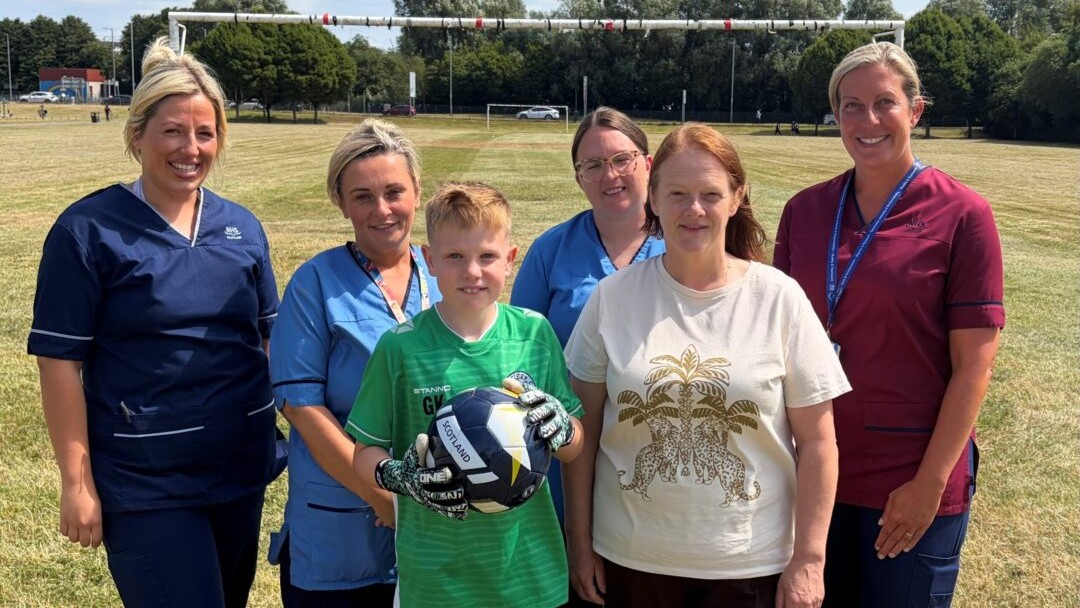
That transformation came into sharp focus as Minister for Community Care Alison Thewliss MSP recently visited University Hospital Wishaw to see first-hand how NHS Lanarkshire is bringing together specialist teams, innovative models of care and digital technology to redesign care around patients.
Among those she met was 11-year-old Ollie Doran, goalkeeper for Coatbridge City FC, who shared how Paediatric Hospital at Home enabled him to receive specialist treatment in his own home while remaining connected to school, family life – and the football he loves.
The Community Care Minister said: “I would like to thank all of the staff from this wide range of specialties who are working together to deliver Hospital at Home. NHS Lanarkshire has pioneered this work and I am delighted that University Hospital Wishaw is continuing to lead on this important initiative.
“Across Scotland more than 7,500 patients were accepted into services between February and April this year. We have invested an additional £100 million to build on the progress made and help build the largest ‘hospital’ in the country.
“Meeting Ollie and hearing his story brought home exactly why this matters. Advances in Lanarkshire demonstrate how collaboration, innovation and technology are reshaping the future of health and care across Scotland.”
Today, Hospital at Home is no longer a single service. During the visit, the Minister heard from teams delivering Paediatric Hospital at Home, the Frailty Unit and the award-winning Frailty Hospital at Home service before learning more about the Community Response Team, specialist intravenous antibiotic services (OPAT) and Virtual Wards.
The visit showcased how closer collaboration between these services is driving the next phase of Hospital at Home. By bringing together specialist expertise, digital technology and multidisciplinary teams, NHS Lanarkshire is creating new opportunities to deliver more personalised care, improve patient experience and ensure more people can receive specialist treatment at home whenever it is safe and appropriate.
The visit also provided an opportunity to discuss future ambitions for Hospital at Home, including continued service development, greater use of digital technology, continued workforce development and stronger partnerships across health and social care to make hospital-level care at home available to even more people.
Claire Ritchie, Service Director of Interface, NHS Lanarkshire, said: “Fifteen years ago, Hospital at Home challenged the traditional assumption that people experiencing acute illness always needed to come into hospital.
“Today, that original idea has grown into something much bigger. What started as pioneering care for older people living with frailty has evolved into an integrated programme delivering hospital-level care throughout people’s lives – from childhood to later life – and bringing together specialist teams from across NHS Lanarkshire.
“The real innovation is no longer any one service in isolation. It is how our teams work together, share expertise and use technology to deliver hospital-level care wherever patients will benefit most.”
NHS Lanarkshire Board Chair Katharina Kasper added:
“The visit demonstrated just how far Hospital at Home has come, but it also highlighted the opportunities ahead.
“By continuing to strengthen collaboration across specialties and embracing new models of care, we can reach more people, deliver more care closer to home and continue redefining how hospital care can be delivered across Lanarkshire.”
“It meant he could just be Ollie”
How Hospital at Home kept a young goalkeeper doing what he loves
Just days after his 11th birthday, Ollie Doran has plenty to celebrate.
Recently the young Coatbridge City FC goalkeeper helped his team secure five victories from five matches at a tournament in Loch Lomond, keeping two clean sheets along the way.
For most young footballers, it was simply another brilliant weekend doing what they love.
For Ollie and his family, it represented something much bigger.
Living with bilateral bronchiectasis and ADHD means Ollie faces daily health challenges that most children never have to think about. Several times a year he requires intensive courses of intravenous antibiotics to treat serious chest infections. Until recently, that meant spending up to two weeks in hospital.
Those admissions didn’t just interrupt his treatment.
They interrupted his childhood.
They meant disrupting the routines that help Ollie thrive and coping with the bright lights, unfamiliar surroundings and constant activity of a busy hospital environment – something that can be particularly overwhelming for a neurodivergent child.
His mum, Karen, says the impact reached far beyond the hospital ward.
“Hospital admissions affected every part of family life,” she said.
“They meant time away from home, extra travelling and trying to juggle everything around Ollie’s treatment. But for Ollie himself, the biggest thing was losing that sense of normality.
“Routine is really important to him. Football is his happy place. His teammates are his friends and those social connections are a huge part of his confidence and development. Every time he had to go into hospital, all of that stopped.”
Everything changed when Ollie became one of the first children to benefit from NHS Lanarkshire’s Paediatric Hospital at Home service.
Instead of spending up to two weeks on a hospital ward, specialist children’s nurses brought his hospital treatment to him.
Receiving intravenous antibiotics safely at home meant Ollie could sleep in his own bed, spend time with his family and, when he felt well enough, remain connected to the routines that mattered most.
When he needed treatment over Christmas and New Year, the difference was especially profound.
Rather than spending much of the festive period in hospital, Ollie was able to wake up at home on Christmas morning, celebrate with his family and create memories that otherwise would have been lost.
“That was priceless,” Karen said.
“His clinical care was exactly the same, but emotionally it made such a difference. He was surrounded by the people who make him feel safe.”
For Ollie, though, one thing mattered almost as much as Christmas.
Football.
A passionate goalkeeper, he trains three evenings every week and plays matches at the weekend. During the World Cup, he barely missed a game and spent every half-time interval outside practising diving saves in the garden before rushing back in for the second half.
“He’s football mad,” Karen laughed.
“If there’s a ball nearby, he’ll be practising. Goalkeeping has given him so much. It keeps him active, gives him confidence and has helped him build friendships that are incredibly important to him.”
Being treated at home meant those connections didn’t disappear every time he became unwell.
Instead, he could continue being part of his team and return to training far sooner than would previously have been possible.
Karen believes the service has transformed life for the whole family.
“Hospital at Home doesn’t just treat Ollie’s condition – it helps him keep being himself. It allows him to stay connected to school, to football and to his friends. That normality is so important for every child, but especially for Ollie.
“As parents, you want your child to receive the very best clinical care. Hospital at Home has given us that while allowing him to recover where he feels happiest – at home.”
Paediatric Hospital at Home
Launched in December 2025, Paediatric Hospital at Home provides hospital-level assessment, treatment and ongoing monitoring for children and young people in their own homes whenever it is clinically safe to do so.
Working closely with paediatric consultants and ward teams, the multidisciplinary service delivers the same specialist care children would receive in hospital while reducing disruption to family life. Children can recover in familiar surroundings, maintain normal routines and spend more time with family and friends while remaining under the care of hospital specialists.
Factfile
What is Hospital at Home?
Hospital at Home is an integrated NHS Lanarkshire programme delivering urgent, short-term hospital-level care in people’s own homes as a safe and effective alternative to a hospital stay, where it is clinically appropriate to do so.
Bringing together specialist teams from across acute, community and primary care, the programme helps people avoid unnecessary hospital admissions or return home sooner while continuing to receive safe, high-quality hospital care in familiar surroundings.
Dr Lucy Munro, Medical Director, of Health and Social Care North Lanarkshire, said: “Patient safety is at the heart of every Hospital at Home pathway. People are only cared for at home where it is clinically appropriate, safe and effective to do so, following careful clinical assessment and with the support of specialist multidisciplinary teams.
“Hospital at Home is not about replacing hospital care. It is about delivering the right care, in the right place, at the right time. For many patients, receiving hospital-level treatment at home can be just as safe and effective as a hospital stay, while allowing them to remain in familiar surroundings with the support of family and carers.”
Hospital at Home services in NHS Lanarkshire
• Frailty Hospital at Home – assessment and treatment for older people living with frailty.
• Paediatric Hospital at Home – hospital-level care for children and young people in their own homes.
• Respiratory Community Response Team – rapid assessment, treatment and monitoring for people with serious respiratory illness.
• Outpatient Parenteral Antimicrobial Therapy (OPAT) – intravenous antibiotic treatment delivered safely at home.
• Virtual Wards – using remote monitoring and digital technology alongside regular clinical oversight to support patients safely at home
• Flow Navigation Centre Plus (FNC Plus) – connects patients quickly to the right care through expert clinical navigation.